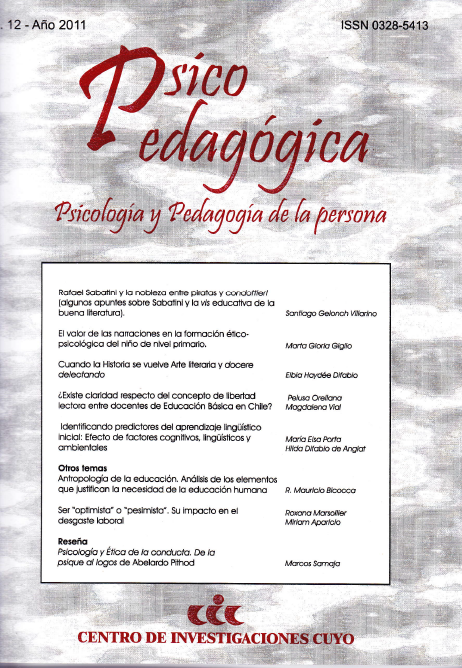
¿EXISTE CLARIDAD RESPECTO DEL CONCEPTO DE LIBERTAD LECTORA ENTRE PROFESORES DE EDUCACIÓN BÁSICA EN CHILE?
Resumen
Este artículo analiza el desarrollo y las creencias sobre la lectura personal recreativa. Para ello, se encuestó a 48 profesores sobre la lectura recreativa, el tiempo dedicado, el tipo de actividades, dificultades, materiales y evaluación. Los principales hallazgos indican que los profesores: 1. No tienen nociones claras sobre la existencia de diversos tipos de lectura, 2. Desarrollan principalmente una lectura centrada en aspectos mecánicos, mediante los cuales la comprensión es evaluada de manera literal en un contexto dirigido y sin espacios para la elección y 3. Perciben las causas del bajo interés lector a factores externos a su tarea de educadores tales como el hogar y la familia, la falta de interés de los propios niños o la falta de libros adecuados.
Citas
Allington, R., & Baker, K. (1999). Best practices in literacy instruction for children with special needs. En Gambrell, L., Mandel Morrow, L., Neumann, S. & Pressley, M. (Eds.). Best Practices in Literacy Instruction. New York: Guilford Press, 258-270.
Applegate, A., & Applegate, M. (2004). The Peter Effect: Reading habits and attitudes of preservice teachers. The Reading Teacher, 57, 554-563.
Boulware, B.J., & Foley, C.L. (1998). Recreational reading: choices of fourth graders. Journal of Reading Education, 23(2), 17-22.
Chen, S-Y (2008). Who is the avid adolescent reader in Taiwan? The role of gender, family, and teacher. Journal of Adolescent and Adult Literacy, 52(3), 214-223.
Crespo, N. (2001). La construcción del concepto de lectura en el interior del aula de lengua. Onomazein, 6, 223-238.
Cunningham, A. & Stanovich, K. (1997). Early reading acquisition and its relation to reading experience and ability 10 years later. Developmental Psychology, 33(6), 934-945.
Deci, E. L., Koestner, R. & Ryan, R. M. (2001). Extrinsic rewards and intrinsic motivation in education: Reconsidered once again. Review of Educational Research, 71, 1-27.
Draper, M. C., Barksdale-Ladd, M. A. & Radencich, M. C. (2000). Reading writing habits of preservice teachers. Reading Horizons, 40(3), 185-203.
Durkin, D. (1966). Children who read early. New York: Teachers College Press.
Durkin, D (1978/79). What classroom observations reveal about reading comprehension instruction. Reading Research Quarterly, 41, 481-533.
Edmunds, K.M., & Bauserman, K.L. (2006). What teachers can learn about reading motivation through conversations with children. The Reading Teacher, 59(5), 414–424.
Eyzaguirre, B. & Fontaine, L. (Eds.) (1997). El Futuro en Riesgo. Nuestros Textos Escolares. Santiago: Centro de Estudios Públicos.
Eyzaguirre, B. & Fontaine, L. (2008) Las Escuelas que Tenemos. Santiago: Centro de Estudios Públicos.
Fountas, I. & Pinnell, G.S. (2001) Guiding Readers and Writers, grades 3-6. Portsmouth, NH: Heinemann.
Gambrell, L.B., Palmer, B., Codling, R. & Mazzoni, S. (1996). Assessing Motivation to Read. The Reading Teacher, 49(7), 518–533.
Gambrell, L., Mandel Morrow, L., Neuman, S.B. & Pressley, M. (1999). Best Practices in Literacy Instruction. New York: Guilford Press.
Gassol, A. & Aranega, M. (2000). Descubrir el Placer de la Lectura. Barcelona: Editorial Edebé.
Guthrie, J.T., Wigfield, A. & Perencevich, K.C. (Eds.). (2004). Motivating reading comprehension: Concept-oriented reading instruction. Mahwah, NJ: Erlbaum.
Harris, A.J. & Sipay, E.R. (1990). How to increase reading ability: A guide to developmental and remedial methods (9ª ed.). White Plains, NY: Longman.
Heathington, B. S. & Alexander, J.E. (1984). Do classroom teachers emphasize attitude towards reading? The Reading Teacher, 37, 484-488.
Kamil, M. (2008). How to get recreational reading to increase reading ability. En Kim, Y, Risko, V., Compton, D., Dickinson, D., Hundley, M., Jiménez, R., Leander, K. & Rowe, D.W. 57th Yearbook of the National Reading Conference. National Reading conference, Inc. Oak Creek, WI.
Kirsch, J., de Jong, J, La Fontaine, D., McQueen, J. & Monseur, C. (2000). Reading for Change: Performance and engagement across countries. Results from PISA 2000. Paris: OECD.
Krashen, Stephen D. & Tracy D. Terrell. (1983). The natural approach: Language acquisition in the classroom. Hayward, CA: Alemany Press.
Ibáñez Langlois, J.M. (1993) Introducción a la Literatura. Santiago: Editorial Universitaria.
Lehman, B.A., Freeman, E.B. & Allen, V.G. (1994). Children’s literature and literacy instruction: «Literature-based» elementary teachers’ belief and practices. Reading Horizons, 35, 3-23.
Llano, A. (1985). El futuro de la libertad. Pamplona: Eunsa. Luttrell & Parker (2001). High school students’ literacy practices and identities, and the figured world of school. Journal of Research in Reading, 24(3), 235-244.
Lutz, S.L., Guthrie, J.T. & Davis, M.H. (2006). Scaffolding for engagement in learning:An observational study of elementary school reading instruction. Journal of Educational Research, 100, 3-20.
McKenna, M. (2001). Development of reading attitudes. In L. Verhoeven & C. Snow (Eds.), Literacy and motivation: Reading engagement in individuals and groups (135-158). Mahwah, NJ: Lawrence Erlbaum.
McKenna, M., Kear, D. & Ellsworth, R. (1995). Children’s attitudes toward reading. A national survey. Reading Research Quarterly, 30, 934-956.
Medina, A. (2006). Enseñar a leer y a escribir. ¿En qué conceptos fundamentar las prácticas docentes? Psykhé, 15(2), 45-55.
Mellon, C.A. (1990). Leisure reading choices of rural teens. School Library Media Quarterly. Summer: 223–228.
Mistral, G. (1979). Magisterio y Niño. Santiago: Editorial Andrés Bello.
Mohr, K. (2006). Children’s choices for recreational reading: a three-part investigation of selection preferences, rationales, and processes. Journal of Literacy Research, 38(1), 81-104.
Morrison, T.G., Jacobs, J.S. & Swinyard, W.R. (1999). Do teachers who read personally use recommended literacy practices in their classrooms? Reading Research and Instruction, 38(2), 81-100.
Morrow, L.M. (1983). Home and school correlates of early interest in literature. Journal of Educational Research, 76, 221-230.
Morrow, L.M. (1986). Attitudes of teachers, principals, and parents toward promoting voluntary reading in the elementary school. Reading Research and Instructions, 25(2), 116-130.
Mour, S.I. (1977). Do teachers read? The Reading Teacher, 30, 397-401.
Mueller, D.L. (1973). Teacher attitudes toward reading. Journal of Reading, 17, 202-205.
Nathanson, S., Pruslow, J. & Levitt, R. (2008). The reading habits and literacy attitudes of inservice and prospective teachers: results of a questionnaire survey. Journal of Teacher Education, 59(4), 313-319.
Pennac, D. (1996). Como una novela. Bogotá: Norma.
Petit, M. (1999). Nuevos Acercamientos al Niño y la Lectura. México: Fondo de Cultura Económica.
Powell-Brown, A. (2003/2004). Can you be a teacher of literacy if you don’t love to read? Journal of Adolescent & Adult Literacy, 47, 284-288.
Reutzel, D.R. & Sabey, B. (1996). Teacher beliefs and children’s concepts about reading: Are they related? Reading Research and Instruction, 35, 323-342.
Rosenblatt, L. (1978). The reader, the text, the poem: The transactional theory of the literary work. Carbondale, IL: Southern Illinois Press.
Stanovich, K.E. (1986). Matthew effects in reading: Some consequences of individual differences in the acquisition of reading. Reading Research Quarterly, 21, 360–407.
Stanovich, K.E., West, R.F., Cunningham, A.E., Cipielewski, J. & Siddiqui, S. (1996). The role of inadequate print exposure as a determinant of reading comprehension problems. En C. Cornoldi & J. Oakhill (Eds.), Reading comprehension disabilities: processes and intervention (5-32). Mahwah, NJ: Erlbaum.
Strasser, K., Lissi, M.R., Silva, M. & Altamirano, M. (2009). Gestión del tiempo en 12 salas chilenas de Kindergarten: recreo, colación, y algo de instrucción. Psykhe, 18(1), 85-96.
Strommen, L. & Mates, B. (2004). Learning to Love Reading: Interviews With Older Children and Teens. Journal of Adolescent & Adult Literacy, 48(3), 188–200.
Taboada, A., Tonks, S.M., Wigfield, A. & Guthrie, J.T. (2009). Effects of motivational and cognitive variables on reading comprehension. Reading and Writing: An Interdisciplinary Journal, 22, 85-106.
Taylor, B.M., Frye, B.J. & Maruyama, G. (1990). Time spent reading and reading growth. American Educational Research Journal, 27, 351-362.
Teale, W.H. (1986). Reading to young children: Its significance for literacy development. In Awakening to literacy. Edited by H. Goelman, A. Oberg, and F. Smith. Portsmouth, N.H.: Heinemann.
Wigfield, A., Guthrie, J.T., Tonks, S. & Perencevich, K.C. (2004). Children’s motivation for reading: Domain specificity and instructional influences. Journal of Educational Research, 97, 299-309.
Wilson J. & Casier, L. (2007) Understanding the Recreational Reading Patterns of Secondary Students. Reading Improvement, 44(1), 40-49, Project Innovation, Inc
Unrau, N. & Schlackman, J. (2006). Motivation and its relationship with reading achievement in an urban middle school. Journal of Educational Research, 100(2), 81-101.